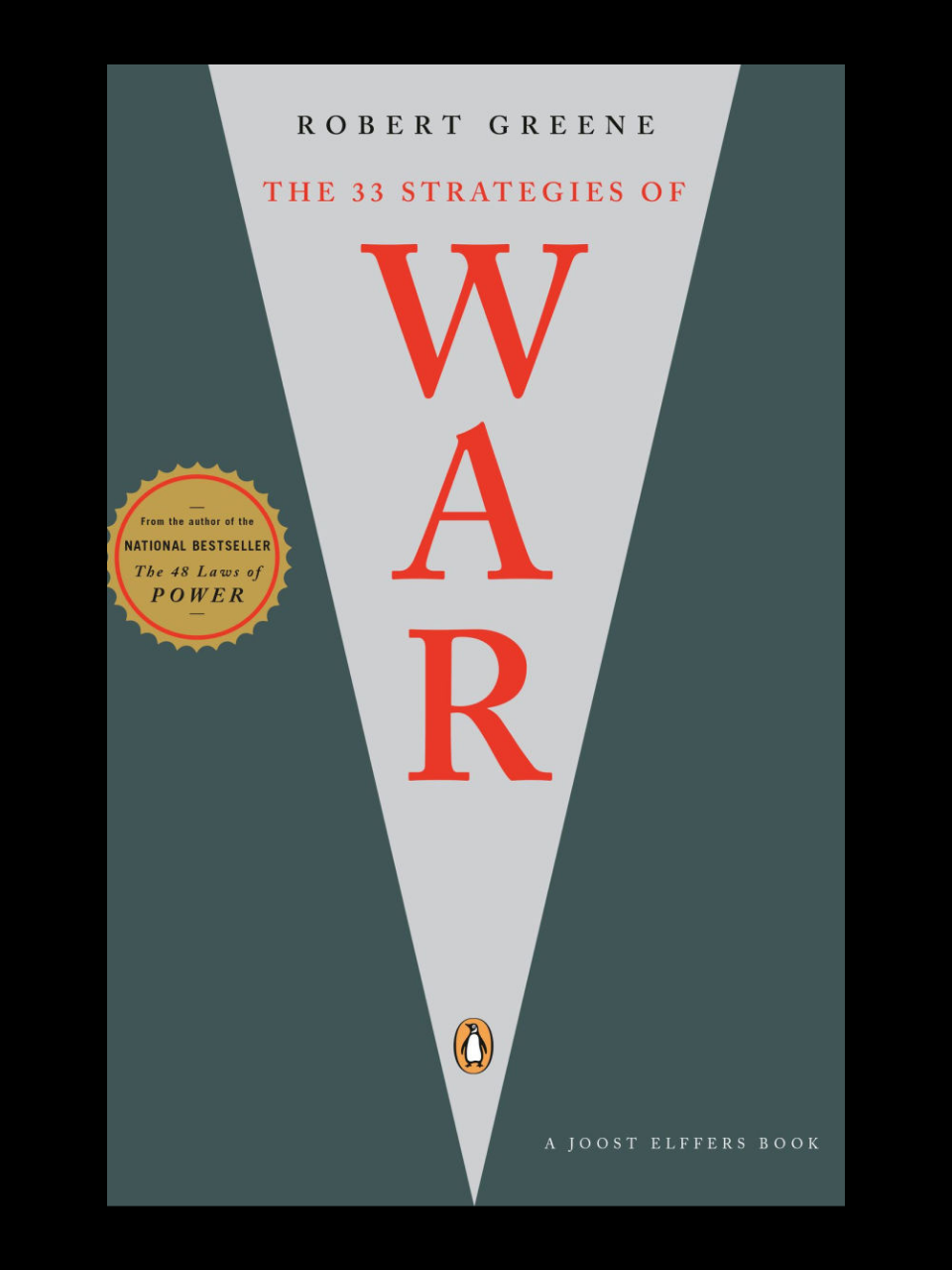
The 33 Strategies Of War By Robert Greene
VAT exclusive · Delivery calculated at checkout
Master the Art of Strategic Conflict with The 33 Strategies Of War by Robert Greene
The 33 Strategies Of War by Robert Greene readers around the world are discovering is far more than a book about military tactics—it is a comprehensive guide to the subtle social game of everyday life, informed by the most ingenious and effective principles in warfare. Robert Greene, the modern master of strategy and power, has crafted an indispensable addition to his ruthless and unique series that includes The 48 Laws of Power, The Art of Seduction, and Mastery.
Spanning world civilizations, synthesizing dozens of political, philosophical, and religious texts, and drawing from thousands of years of violent conflict, The 33 Strategies Of War by Robert Greene is the I-Ching of conflict, the contemporary companion to Sun Tzu’s timeless classic The Art of War It is composed of discussions and examples of offensive and defensive strategies from a wide variety of people and conditions, applying them directly to the social conflicts we all face—from family quarrels to high-stakes business negotiations.
For ambitious Cameroonians navigating the competitive and often ruthless landscapes of Douala, Yaoundé, Buea, Bamenda, and Limbe, the wisdom Robert Greene shares in The 33 Strategies Of War by Robert Greene will fundamentally transform how you approach conflict, competition, and the pursuit of power.
About the Author Robert Greene: Why His Wisdom Matters in The 33 Strategies Of War by Robert Greene
The 33 Strategies of War by Robert Greene readers benefit from the insights of one of the world’s most renowned experts on strategy, power, and human behavior. Robert Greene, born in Los Angeles in 1959, studied classical studies at the University of California, Berkeley, and the University of Wisconsin–Madison. Before becoming an author, he estimates he worked about fifty jobs—as a construction worker, translator, magazine editor, and Hollywood movie writer—giving him an intimate understanding of the gritty realities of power dynamics.
In 1995, Greene met a book packager named Joost Elffers at an art and media school in Italy. Greene pitched a book about power and wrote a treatment which eventually became the international phenomenon The 48 Laws of Power, which has sold over 1.2 million copies and has been referenced by everyone from 50 Cent to Jay-Z to Will Smith. He would note this as the turning point of his life.
Geene has since written seven international bestsellers, including The Art of Seduction, The 33 Strategies Of Waofby Robert Greene, The 50th Law (with rapper 50 Cent), Mastery, The Laws of Human Nature, and The Daily Laws. His works have been referenced by a wide variety of celebrities, political figures, and civil rightactivistsst. Interestingly, Greene is the most banned author in prisons in the United States; many prisons ban his books as a security measure because they are seen as too effective as manuals for power and strategy.
When you read The 33 Strategies Of War by Robert Greene, you’re learning from a man who can speak five languages, is a student of Zen Buddhism, and has dedicated his life to understanding the timeless dynamics of human conflict.
The Revolutionary Framework of The 33 Strategies Of War by Robert Greene
The 33 Strategies Of War by Robert Greene is brilliantly organized into five distinct sections, each addressing a different dimension of warfare as it applies to the conflicts of modern life.
Part I: Self-Directed Warfare in The 33 Strategies Of War by Robert Greene
The first section of The 33 Strategies Of War by Robert Greene focuses on the most important battlefield of all: the internal one. Robert Greene emphasizes that before you can defeat external enemies, you must first conquer yourself. This section encourages deep self-reflection and strategic action tailored to one’s life circumstances
The strategies here teach you to:
-
Declare war on your own weaknesses and self-destructive patterns
-
Create a sense of urgency and purpose that fuels relentless action
-
Develop the mental toughness to endure hardship and uncertainty
-
Transform adversity into advantage through disciplined self-mastery
Part II: Organizational (Team) Warfare in The 33 Strategies Of War by Robert Greene
The second section of The 33 Strategies Of War by Robert Greene addresses the challenges of leading and motivating groups of people. Robert Greene draws on examples from history’s greatest generals and leaders to illustrate how to build cohesive, effective teams that can execute complex strategies.
Key insights include:
-
The importance of creating a shared mission that inspires loyalty
-
How to manage the inevitable conflicts and rivalries within any group
-
The art of delegating authority while maintaining ultimate control
-
Strategies for turning a disparate collection of individuals into a unified force
Part III: Defensive Warfare in The 33 Strategies Of War by Robert Greene
The third section of The 33 Strategies Of War by Robert Greene is designed to help you respond to dangerous situations and avoid unwinnable wars. Robert Greene teaches that sometimes the most brilliant strategy is knowing when not to fight.
Defensive strategies include:
-
The art of picking your battles and conserving your resources
-
How to create defensive positions that force your enemies to exhaust themselves attacking you
-
The wisdom of retreating strategically to live and fight another day
-
Techniques for turning your opponent’s aggression against them
Part IV: Offensive Warfare in The 33 Strategies Of War by Robert Greene
The fourth section of The 33 Strategies Of War by Robert Greene focuses on the strategies that require you to maintain the initiative and negotiate from a position of strength. This is where Robert Greene’s analysis of history’s greatest military minds comes to the forefront.
Offensive strategies teach you to:
-
Strike first with overwhelming force to unnerve and disorient your enemies
-
Create momentum that carries you through obstacles and resistance
-
Adapt rapidly to changing circumstances and seize emerging opportunities
-
Keep your opponents off-balance and unable to mount an effective defense
Part V: Unconventional (Dirty) Warfare in The 33 Strategies Of War by Robert Greene
The final section of The 33 Strategies Of War by Robert Greene is one of the book’s longest, dealing with the messy, ambiguous reality of conflict when all rules are off. Robert Greene draws on examples from guerrilla warfare, insurgencies, and the most ruthless power players in history.
These strategies cover:
-
How to wage war by indirect means when you lack conventional strength
-
The art of deception, misdirection, and psychological operations
-
Strategies for turning the weaknesses of your enemies into weapons against them
-
How to create chaos and confusion in the ranks of your opponents
Inspiring Case Studies from The 33 Strategies Of War by Robert Greene
The 33 Strategies of War by Robert Greene is abundantly illustrated with examples from history, bringing each strategy to life through compelling stories of both folly and genius. Robert Greene draws from an extraordinary range of figures: Napoleon, Margaret Thatcher, Shaka the Zulu, Lord Nelson, Hannibal, Ulysses S. Grant, as well as movie moguls, Samurai swordsmen, and diplomats.
Queen Elizabeth I: The Strategy of Exhaustion
In The 33 Strategies Of War by Robert Greene, one of the most illuminating examples is Queen Elizabeth I’s handling of King Philip II of Spain. When Elizabeth ascended the throne, England was torn by civil war and financial chaos, facing powerful enemies in France and Spain. Rather than confront the Spanish Armada directly, Elizabeth secretly engaged her captain, Sir Francis Drake, who appeared to the world as a pirate, to capture Spanish treasure ships. With each capture, the interest in Philip II’s loans increased. By the time the Armada finally launched, it had been so delayed and weakened that England’s mobile fleet could destroy it. This is considered one of the most cost-effective victories by a second-rate nation over a powerhouse. The lesson from The 33 Strategies Of War by Robert Greene is clear: when facing a more powerful enemy, exhaust them indirectly rather than confronting them head-on.
Mao Tse-tung: The Strategy of Retreat
Another powerful example in The 33 Strategies Of War by Robert Greene is Mao’s campaign against the Nationalists. When Soviet-influenced intellectuals within the Communist Party advocated taking the Nationalists head-on, they isolated Mao and stripped him of power. The result was catastrophic—the Nationalists, better equipped and more numerous, killed communists by the thousands. Mao eventually re-emerged, advocating a strategy of retreat and guerrilla warfare based on peasant revolution. By retreating strategically, Mao bought time, recovered strength, and eventually defeated the Nationalists in 1949. The 33 Strategies Of War by Robert Greene teaches that retreating from a strong enemy is not a sign of weakness—it is wisdom that allows you to fight another day.
The Soviet Union in Afghanistan: The Strategy of Knowing When to Stop
The 33 Strategies Of War by Robert Greene also includes cautionary tales, such as the Soviet Union’s disastrous intervention in Afghanistan. The Soviets, hoping to make Afghanistan a satellite state, found themselves entangled in a bitter conflict with mujahedin fighters, secretly funded and armed by the United States. The stubborn resistance dragged on far too long, draining the Soviet Union both psychologically and financially, and ended in a major fiasco. The wisdom of The 33 Strategies Of War by Robert Greene teaches us that you must know when to stop. If a conflict is unnecessarily stretched, it not only creates bitter enemies but keeps you entangled in future conflicts. The objective is not only winning a war but winning it in a manner that sets you up for the next round.
Napoleon and the Prussians: The Strategy of Innovation
The Prussian king Frederick the Great introduced ingenious new strategies that brought immense success. However, his future generations followed his methods as rigid precepts until they became stale. The French developed better, radical new ideas that Napoleon implemented to crush the Prussians at the Battle of Jena-Auerstadt. The Prussians then studied Napoleon’s success, adapted his best practices with refinement, and later contributed to Napoleon’s defeat at Waterloo. The 33 Strategies Of War by Robert Greene uses this story to illustrate that an unorthodox strategy has a novelty factor that surprises opponents—but if repeated, it becomes conventional and loses its power.
Alfred Hitchcock: The Detached-Buddha Tactic
Not all examples in The 33 Strategies Of War by Robert Greene are from the battlefield. Robert Greene uses the master filmmaker Alfred Hitchcock to illustrate the “detached-Buddha tactic”—appearing uninvolved while remaining in total control. Hitchcock’s calm, methodical approach on set and his meticulous pre-planning of every shot allowed him to maintain absolute creative authority while seeming relaxed and unconcerned. This strategy from The 33 Strategies Of War by Robert Greene applies perfectly to modern business leaders and professionals who need to project calm authority while orchestrating complex operations.
Key Concepts in The 33 Strategies Of War by Robert Greene
The Rational, Resourceful, and Intuitive Always Defeat the Panicked and Uncreative
Throughout The 33 Strategies Of War by Robert Greene, a central theme emerges: the great warriors of battlefields and drawing rooms alike demonstrate prudence, agility, balance, and calm. They possess a keen understanding that the rational, resourceful, and intuitive always defeat the panicked, the uncreative, and the stupid. Greene argues that when our routines are disturbed, and circumstances place us in adverse conditions, we react to pressure—we become debilitated, impatient, and confused. In hours of adversity, our mind is weaker than our emotions. This is precisely when we need strength and presence of mind. The 33 Strategies of War by Robert Greene teaches us how to make our minds stronger by controlling emotions with discipline and mental toughness, and by developing cognitive attributes that serve us under fire.
The Illusion of Rationality
One of the most provocative ideas in The 33 Strategies Of War by Robert Greene is that we humans love to maintain the illusion that we are rational creatures. We are calm, controlled, and composed when following conventional daily routines. But once the routine is disturbed, our rationality goes out the window, and our emotional side comes to the forefront. In real life, when we are under attack, our responses are those of anger, betrayal, and confusion. The 33 Strategies of War by Robert Greene forces us to confront this uncomfortable truth and prepare for it.
Adaptability Over Rigid Formulas
Another crucial lesson from The 33 Strategies Of War by Robert Greene is that what worked yesterday may not work tomorrow. People expect your behavior to follow known patterns; your earlier behavior becomes a precedent. Once your behavior conforms to unpredictability, you upset their calculations. An unorthodox strategy has a novelty factor, which may surprise your opponent. If repeated, the strategy becomes conventional and at times delusional. The 33 Strategies Of War by Robert Greene insists that we must remain fluid, adaptable, and willing to abandon even our most successful tactics when circumstances change.
Know When to Stop
The wisdom of strategy, as revealed in The 33 Strategies Of War by Robert Greene, says that you must avoid all conflicts where there are no realistic exits. The objective is not only winning a war but winning it in the right manner, which sets you up for the next round of conflict. This principle has profound applications for business negotiations, career decisions, and personal relationships.
A Balanced Perspective on The 33 Strategies Of War by Robert Greene
The 33 Strategies of War by Robert Greene has received both praise and criticism since its publication in 2006. The Independent said Greene has set himself up as “a modern-day Machiavelli” but questioned whether he really believes what he writes or whether it is just his shtick. Admiral James G. Stavridis noted that the book had good breadth but lacked depth. Leadership theorist John Adair argued that Greene “shows a poor grasp of the subject”, and the book is based on the flawed assumption that the art of military strategy and the art of living are comparable.
However, The Sunday Times called the book “an excellent toolkit for dealing with business and relationships,” And NBA player Chris Bosh has repeatedly stated that his favorite book is The 33 Strategies Of War by Robert Greene. The book has sold more than 200,000 copies and has been part of reading lists ranging from Indigenous leadership forums to seminary courses in Christian apologetics.
The truth, as with any ambitious work, lies somewhere in between. The 33 Strategies of War by Robert Greene offers an unparalleled compilation of historical examples and strategic frameworks. Whether you agree with Greene’s philosophy or not, the book will make you think more deeply about conflict, power, and human nature.
Why The 33 Strategies Of War by Robert Greene Matters for Cameroonians
The 33 Strategies of War by Robert Greene arrives at a crucial moment for Cameroon’s professional, entrepreneurial, and personal communities. In the dynamic and often challenging environments of Douala, Yaoundé, Buea, and Bamenda, the ability to navigate conflict strategically can mean the difference between success and failure.
Whether you’re:
-
An entrepreneur in Douala is facing intense competition and needs to outmaneuver rivals
-
A business negotiator in Yaoundé seeking to maintain the initiative and negotiate from strength
-
A professional in Buea navigating office politics and subtle power dynamics
-
A community leader in Bamenda is trying to unite people toward a common goal
-
A student preparing to enter a competitive job market and wanting to understand the unwritten rules of success
-
Anyone who has ever felt outmatched, outmaneuvered, or outgunned in a conflict
The 33 Strategies Of War by Robert Greene provides the strategic framework you need to assess situations clearly, choose your battles wisely, and act with decisiveness and confidence.
What Readers Are Saying About The 33 Strategies Of War by Robert Greene
The 33 Strategies of War by Robert Greene has received passionate responses from readers worldwide. With thousands of reviews across platforms, the book has clearly resonated deeply with those seeking to understand and master conflict.
One reader shares: “So well referenced and thought through, R.G is really a brilliant human behavior & psychology analyst. Very thorough and interesting!”
Another writes: “The book contains distilled, refined and timeless wisdom on principles of warfare, recorded in dossiers… The author has beautifully placed each strategy in a modern and personal context. He has done so by reaching into a rich treasure trove of history. He has a penchant for presenting knotty issues with his trademark sublime touch. This book is highly recommended.”
A third reviewer notes: “Despite its length and lack of chapter summaries, the actionable strategies and compelling examples make it worthwhile. If you’re interested in broadening your strategic thinking—whether in personal growth, business, or everyday conflicts—this book is a powerful, insightful read. It’s a modern classic for anyone looking to enhance their understanding of human behavior and strategic dynamics.”
Some readers offer balanced perspectives: “There is a debate whether we human beings are rational or emotional creatures. We would like to call ourselves rational creatures because it sounds good. We love to maintain that illusion. This book challenges that illusion and offers strategies for when our rationality fails us.”
Your Strategic Journey with The 33 Strategies Of War by Robert Greene Starts Here
Imagine waking up each day with the strategic mindset of history’s greatest military minds. Imagine facing conflicts not with anxiety and confusion, but with the calm confidence that you have a framework for action. Imagine outmaneuvering competitors not through brute force, but through superior strategy and timing.
That is the transformation The 33 Strategies Of War by Robert Greene offers to every reader who studies its pages.
As Robert Greene writes, the great warriors of battlefields and drawing rooms alike demonstrate prudence, agility, balance, and calm, and a keen understanding that the rational, resourceful, and intuitive always defeat the panicked, the uncreative, and the stupid. This book is designed to cultivate those very qualities in you.
FAQ:
1. What exactly is The 33 Strategies Of War by Robert Greene about?
The 33 Strategies Of War by Robert Greene is a comprehensive guide to the subtle social conflicts of everyday life, informed by the most ingenious and effective military principles in history. It is composed of discussions and examples of offensive and defensive strategies from a wide variety of people and conditions, applying them to social conflicts such as family quarrels and business negotiations . The book is structured into thirty-three chapters, each outlining a specific strategy, organized into five parts: Self-Directed Warfare, Organizational Warfare, Defensive Warfare, Offensive Warfare, and Unconventional (Dirty) Warfare.
2. Who is Robert Greene, the author of The 33 Strategies of War?
Robert Greene is a #1 New York Times bestselling author and internationally renowned expert on power strategies. He studied classical studies at the University of Wisconsin–Madison and has written seven international bestsellers, including The 48 Laws of Power, The Art of Seduction, and Mastery. His works have been referenced by celebrities, political figures, and civil rights activists, and he is famously the most banned author in US prisons.
3. Do I need to read Sun Tzu’s The Art of War first?
Not at all. While The 33 Strategies Of War by Robert Greene is described as the contemporary companion to Sun Tzu’s classic, it stands completely on its own. Robert Greene synthesizes wisdom from dozens of sources, including Sun Tzu, making the book accessible to readers unfamiliar with military strategy.
4. Is this book only for businesspeople and entrepreneurs?
No. While The 33 Strategies Of War by Robert Greene has powerful applications for business, its principles apply to anyone who faces conflict in any form—professionals, negotiators, athletes, artists, and even those dealing with family dynamics. The book draws examples from movie moguls, Samurai swordsmen, and diplomats alongside military leaders, showing the universal applicability of strategic thinking.
5. How quickly can I get The 33 Strategies Of War by Robert Greene delivered in Cameroon?
We offer fast and reliable delivery across Cameroon. If you’re in major cities like Douala, Yaoundé, Buea, Bamenda, or Limbe, you can expect your order within 24-72 hours. For other locations, delivery times are still impressively quick.
6. What payment methods do you accept for The 33 Strategies Of War by Robert Greene?
For your convenience, we accept all major bank cards and popular local options like Orange Money and MTN Mobile Money at checkout. We want to make getting this essential book by Robert Greene as easy as possible.
7. How long is The 33 Strategies Of War by Robert Greene?
The 33 Strategies of War by Robert Greene is approximately 496-512 pages, depending on the edition. The book is substantial but organized into digestible chapters, each focused on a single strategy. Some readers find the length challenging but ultimately rewarding.
8. Does The 33 Strategies Of War by Robert Greene include historical examples?
Yes, abundantly. The 33 Strategies Of War by Robert Greene is richly illustrated with examples from history, including the folly and genius of figures from Napoleon to Margaret Thatcher, Shaka the Zulu to Lord Nelson, Hannibal to Ulysses S. Grant, as well as movie moguls, Samurai swordsmen, and diplomats. These examples bring each strategy to life and make complex concepts more digestible
9. Is The 33 Strategies of War by Robert Greene considered unethical?
This is a matter of perspective. Some critics have questioned the ethics of applying military strategy to everyday life. However, Robert Greene argues that these dynamics exist whether we acknowledge them or not, and understanding them is a form of self-defense. As one reviewer noted, “The book shakes you up and challenges your virtues… Not everything goes as expected in this nasty and competitive world. Use wisdom with discernment.
10. Who would benefit most from reading The 33 Strategies Of War by Robert Greene?
Anyone interested in broadening their strategic thinking—whether in personal growth, business, or everyday conflicts—will find The 33 Strategies Of War by Robert Greene a powerful, insightful read. It is a modern classic for anyone looking to enhance their understanding of human behavior and strategic dynamics.
Ready to master the subtle art of strategic conflict with The 33 Strategies Of War by Robert Greene?
You don’t have to remain vulnerable to the maneuvers and machinations of others. The timeless wisdom you need to navigate life’s battles with prudence, agility, and calm is waiting for you inside this comprehensive masterwork.
Join readers worldwide—from NBA stars to business leaders to students of power—who have discovered the transformative power of Robert Greene’s strategic genius. Get your copy of The 33 Strategies Of War by Robert Greene today and begin the journey to mastering conflict, outmaneuvering opponents, and forever gaining the upper hand.
Remember: The rational, resourceful, and intuitive always defeat the panicked, the uncreative, and the stupid. Arm yourself with strategy.
You might also like

Reviews
There are no reviews yet.