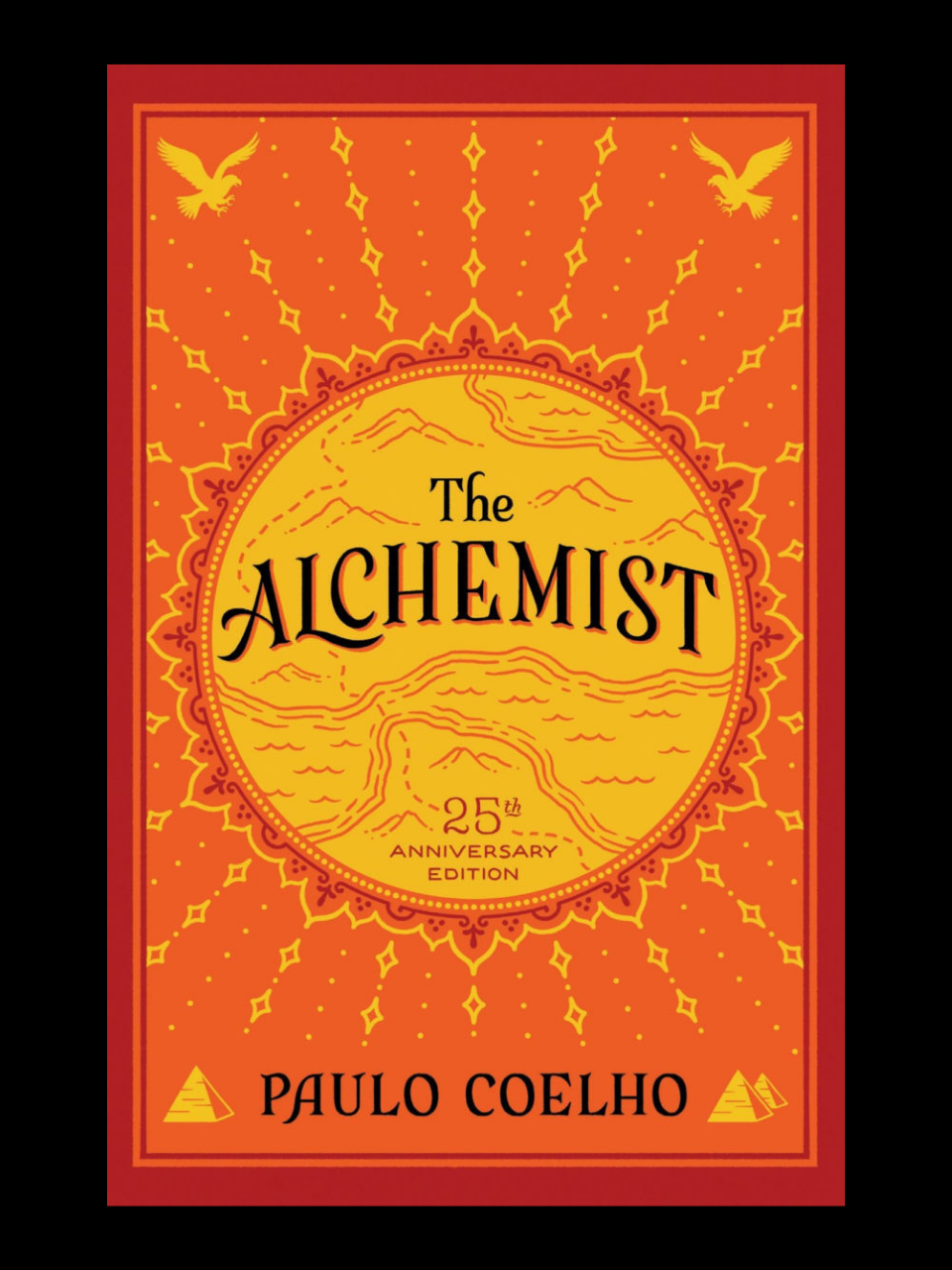
The Alchemist By Paulo Coelho
VAT exclusive · Delivery calculated at checkout
Follow Your Personal Legend with The Alchemist by Paulo Coelho
The Alchemist by Paulo Coelho is far more than a conventional novel; it is a spiritual journey, a philosophical fable, and a self-help guide all woven into one poetic and unforgettable story. First published in 1988, this modern classic has become a cultural phenomenon, inspiring readers from all walks of life with its simple yet profound message about the importance of following our dreams and listening to the language of our hearts.
The story begins in the hills of Andalusia, where a young shepherd named Santiago has a recurring dream about a treasure hidden near the pyramids of Egypt. After consulting a gypsy woman who interprets his dream and meeting a mysterious old man named Melchizedek, who claims to be the King of Salem, Santiago decides to sell his sheep and embark on a perilous journey across the continent in search of his destiny.
For ambitious Cameroonians navigating the vibrant landscapes of Douala, Yaoundé, Buea, Bamenda, and Limbe, the wisdom Paulo Coelho shares in The Alchemist by Paulo Coelho will resonate deeply and perhaps even change the way you see your own life’s journey.
About the Author Paulo Coelho: Why His Wisdom Matters in The Alchemist by Paulo Coelho
Readers of The Alchemist by Paulo Coelho benefit from the extraordinary life experience of one of the world’s most beloved authors. Paulo Coelho was born in Rio de Janeiro, Brazil, in 1947. As a young man, he rebelled against his family’s expectations that he become an engineer, expressing his desire to become a writer. His parents, concerned about his path, had him committed to a psychiatric hospital where he endured electroshock therapy.
Coelho eventually left home and became part of Brazil’s countercultural revolution, experimenting with drugs, dabbling in black magic, and achieving success as a songwriter alongside rock musician Raul Seixas. He was later imprisoned and tortured by Brazil’s military dictatorship for his involvement with an organization considered subversive.
In the mid-1980s, Coelho walked the legendary Camino de Santiago pilgrimage route in Spain, an experience that would transform his life and inspire his first book, The Pilgrimage. The following year, he wrote The Alchemist by Paulo Coelho. The first edition sold so poorly that his publisher declined to reprint it, but Coelho persevered, found a new publisher, and watched his book gradually become a worldwide phenomenon. Today, he is recognized as one of the most widely read authors in history, and his books have touched the lives of millions. When you read The Alchemist by Paulo Coelho, you are reading the work of a man who has lived through extraordinary hardship and emerged with a message of hope and transformation.
The Magical Journey in The Alchemist by Paulo Coelho
Santiago’s Quest Begins
The Alchemist by Paulo Coelho opens with Santiago, a young Andalusian shepherd who chose his profession because it allowed him to travel and meet new people. He sleeps in an abandoned church with a sycamore tree growing through its roof, and it is there that he has his recurring dream: a child tells him that he will find a treasure near the pyramids of Egypt.
Seeking guidance, Santiago visits a gypsy woman who interprets dreams. She tells him that he must go to Egypt, but refuses payment, instead asking for one-tenth of the treasure he will find. Though initially uncertain, Santiago soon encounters an old man named Melchizedek, who reveals himself as the King of Salem. Melchizedek speaks to Santiago about what he calls a “Personal Legend”—the unique destiny that each person is meant to fulfill. He tells the boy, “When you want something, all the universe conspires in helping you to achieve it”. In exchange for one-tenth of his sheep, Melchizedek gives Santiago two magical stones, Urim and Thummim, to help him read the omens.
The Crystal Merchant and the Englishman
Santiago sells his flock and travels to Tangiers, where he is immediately robbed of all his money. Forced to take work with a local crystal merchant, he spends nearly a year learning the trade and helping the merchant’s business prosper. Though the merchant himself has a dream—to make a pilgrimage to Mecca—he has chosen not to pursue it, telling Santiago that it is better to have a dream than to fulfill it, because then you have nothing to live for.
Eventually, Santiago earns enough money to return home, but he meets an Englishman who is traveling with a caravan across the Sahara Desert. The Englishman has spent years studying alchemy and seeks to learn its secrets from a legendary 200-year-old alchemist who lives at an oasis. Inspired by the Englishman’s passion, Santiago decides to continue his own journey toward the pyramids.
The Oasis, Fatima, and the Alchemist
At the oasis, Santiago meets Fatima, a beautiful Arab girl, and they fall deeply in love. Fatima tells him, “Maktub”—an Arabic word meaning “it is written” or “fate”—and explains that if their love is truly part of his destiny, he will return to her after completing his quest.
During his time at the oasis, Santiago demonstrates an ability to interpret omens by foreseeing an impending attack by enemy tribesmen. He warns the chieftains, and after the attack is repelled, Santiago earns their respect and reward. The mysterious alchemist, impressed by Santiago’s abilities, agrees to guide him through the final and most dangerous leg of his journey.
The Final Revelation
The alchemist leads Santiago through the desert, teaching him profound lessons about listening to his heart, understanding the Soul of the World, and recognizing that fear of suffering is often worse than suffering itself. When they are captured by warring tribesmen, the alchemist tells Santiago that he must demonstrate his power by transforming himself into the wind. Through a dialogue with the elements—the wind, the sun, and the hand that wrote all—Santiago connects with the Soul of the World and accomplishes the impossible, securing their release.
Finally reaching the pyramids, Santiago begins to dig where his dream indicated. But he is attacked by refugees, who steal his gold and beat him. As he lies bleeding, one of the attackers mocks him: “I had a dream too, where I saw a treasure in the fields of Spain, where shepherds and their sheep slept under a ruined church with a sycamore growing out of it. But I was not so stupid as to cross an entire desert just because of a dream”.
In that moment, Santiago understands. The treasure he sought was not in Egypt at all—it was waiting for him back in Spain, in the abandoned church where his journey began. He returns home, digs beneath the sycamore tree, and finds a chest of gold and precious jewels. The journey was never about the destination; it was about everything he learned along the way.
Key Themes in The Alchemist by Paulo Coelho
The Personal Legend
Central to The Alchemist by Paulo Coelho is the concept of the Personal Legend—the unique destiny that each person is meant to fulfill in their lifetime. Coelho suggests that we all know, deep within ourselves, what our Personal Legend is, but most of us are too afraid to pursue it. We fear failure, we fear leaving our comfort zones, and we fear what others will think. Yet the novel insists that pursuing our Personal Legend is not merely an option but our only true obligation.
The Soul of the World
Throughout Santiago’s journey, he learns about the Soul of the World—the spiritual force that connects all living things. When we are aligned with our Personal Legend, we become attuned to this universal energy and can read the omens that guide us forward. This concept invites readers to see the world as deeply interconnected and meaningful rather than random and chaotic.
The Language of the Heart
The Alchemist by Paulo Coelho teaches that our hearts speak to us constantly, but we rarely listen. Santiago learns to communicate with his heart, to understand its fears and its wisdom. The alchemist tells him, “Tell your heart that the fear of suffering is worse than the suffering itself. And that no heart has ever suffered when it goes in search of its dreams”.
Maktub: It Is Written
The Arabic word “Maktub” appears throughout the novel, reminding both Santiago and the reader that there is a divine order to the universe. This is not a passive fatalism but rather a recognition that when we are on the right path, the universe will support us. As Melchizedek famously tells Santiago, “When you want something, all the universe conspires in helping you to achieve it”.
Why The Alchemist by Paulo Coelho Has Touched Millions
The Alchemist by Paulo Coelho has achieved a level of cultural impact that few books ever attain. It has sold over 85 million copies worldwide and been translated into more than 80 languages, earning a place in the Guinness World Records as the most translated book by a living author. It has been embraced by readers as diverse as Bill Clinton, Julia Roberts, and Madonna.
What accounts for this extraordinary appeal? The novel speaks to something universal in the human experience—the longing for meaning, the courage to pursue our dreams, and the wisdom to recognize that the greatest treasures are often found not in distant lands but within ourselves and close to home. Its simple, fable-like prose makes its profound philosophy accessible to readers of all ages and backgrounds.
What Readers Are Saying About The Alchemist by Paulo Coelho
The Alchemist by Paulo Coelho has received passionate responses from readers around the world.
One reader shares: “This book is brilliantly written. It touches your heart as the story comes to an end. It teaches that every treasure lies in our own hearts, and there is no need to search for it in the outside world. Search yourself, and you get the world”.
Another reviewer writes: “The Alchemist by Paulo Coelho is a global bestseller, spiritual journey, and self-help guide all rolled into one poetic fable. It is a reminder that your dreams matter, your heart knows the way, and the journey is the point”.
A university library review describes it as “like a warm conversation with a wise friend. The magic of this book lies in its simplicity. Coelho writes in a way that feels almost like a fable, making big ideas about life feel easy to understand”.
A student review notes: “The novel encourages characteristics such as perseverance, resilience, independence, and confidence. The philosophy, themes, and ideas present are truly on different levels of thinking, encouraging all readers to think deeper”.
Some readers offer balanced perspectives. One reviewer comments that while the philosophy is profound, its consistency can become somewhat repetitive, with “every aspect of Santiago’s journey” being philosophized. Another suggests that the book is “only superficially deep” despite its simple storytelling. However, even these critics acknowledge the book’s powerful message and widespread appeal.
Why The Alchemist by Paulo Coelho Matters for Cameroonians
The Alchemist by Paulo Coelho arrives at a crucial moment for Cameroon’s professional, entrepreneurial, and personal development communities. In our rapidly changing world, many people feel pulled between the security of the familiar and the call of their dreams.
Whether you are:
-
An entrepreneur in Douala is risking everything to build something new
-
A professional in Yaoundé is wondering if there is more to life than the daily routine
-
A student in Buea dreaming of a future that feels distant but is calling you forward
-
A business owner in Bamenda seeking to understand their own personal legend
-
A creative in Limbe looking for the courage to share their gifts with the world
-
Anyone who has ever felt that something precious is waiting to be discovered
The Alchemist by Paulo Coelho offers timeless wisdom about the journey we all must take to find ourselves.
Practical Wisdom from The Alchemist by Paulo Coelho
From the pages of The Alchemist by Paulo Coelho, here are insights you can carry with you on your own journey:
-
Trust the journey, even when it is uncertain. Santiago’s path is filled with setbacks—theft, dead ends, and moments of despair—but each obstacle ultimately serves his growth.
-
Listen to your heart. Your deepest intuitions are guiding you toward your Personal Legend. Learn to hear them and trust them.
-
Fear is the greatest obstacle. More than any external barrier, it is our own fear that stops us. The alchemist teaches that fear of suffering is worse than suffering itself.
-
Pay attention to the omens. The universe is always communicating with us if we have eyes to see. The people we meet, the opportunities that arise, the challenges we face—all carry meaning.
-
The treasure is often closer than you think. Santiago’s journey across a continent leads him back to where he began, but he could not have found the treasure without the journey. The wisdom is in the seeking.
Your Journey with The Alchemist by Paulo Coelho Starts Here
Imagine discovering that the treasure you have been seeking your entire life has been waiting for you all along—but you needed the journey to become worthy of it. This is the gift The Alchemist by Paulo Coelho offers to every reader who opens its pages.
As one reader beautifully expressed: “It’s a reminder to pay attention to the little signs in life and to have the courage to chase my own dreams. It’s about realizing that your ‘Personal Legend’—that thing you’re meant to do—is worth fighting for, even if it means leaving your comfort zone”.
FAQ:
1. What exactly is The Alchemist by Paulo Coelho about?
The Alchemist by Paulo Coelho is a novel about Santiago, a young Andalusian shepherd boy who dreams of finding treasure near the Egyptian pyramids and embarks on a journey that transforms his life. It is a philosophical fable about following one’s dreams, listening to one’s heart, and understanding that the journey itself is the true treasure.
2. Who is Paulo Coelho, the author of The Alchemist?
Paulo Coelho is a Brazilian author born in Rio de Janeiro in 1947. He has written numerous international bestsellers and holds the Guinness World Record for the most translated book by a living author. His own life story—including rebellion, imprisonment, and spiritual pilgrimage—informs the wisdom in his books.
3. Why has The Alchemist by Paulo Coelho become so popular worldwide?
The novel speaks to universal human experiences—the longing for meaning, the courage to pursue dreams, and the wisdom to recognize that treasures are often found close to home. Its simple, fable-like style makes profound philosophy accessible to readers of all ages and backgrounds.
4. What is a “Personal Legend” in The Alchemist by Paulo Coelho?
A Personal Legend is the unique destiny that each person is meant to fulfill in their lifetime. The novel suggests that we all know what our Personal Legend is, but often lack the courage to pursue it. Fulfilling one’s Personal Legend is our most important obligation.
5. How quickly can I get The Alchemist by Paulo Coelho delivered in Cameroon?
We offer fast and reliable delivery throughout Cameroon. If you reside in major cities such as Douala, Yaoundé, Buea, Bamenda, or Limbe, you can expect your order within 24 to 72 hours. Deliveries to other locations are also impressively swift.
6. What payment methods do you accept for The Alchemist by Paulo Coelho?
For your convenience, we accept all major bank cards as well as popular local options, including Orange Money and MTN Mobile Money, at checkout. We strive to make acquiring this essential book by Paulo Coelho as seamless as possible.
7. How long is The Alchemist by Paulo Coelho?
The Alchemist by Paulo Coelho is a relatively short novel, approximately 160-180 pages depending on the edition. Many readers finish it in just a few hours, yet its wisdom lingers for a lifetime.
8. Is The Alchemist by Paulo Coelho suitable for young readers?
Absolutely. The book’s simple prose and fable-like quality make it accessible to younger readers, while its philosophical depth offers profound insights for adults. It is widely recommended for students and anyone beginning their journey of self-discovery.
9. What does “Maktub” mean in The Alchemist by Paulo Coelho?
“Maktub” is an Arabic word that appears throughout the novel, meaning “it is written” or “fate”. It suggests that there is a divine order to the universe and that when we are aligned with our destiny, events will unfold as they should.
10. Who would benefit most from reading The Alchemist by Paulo Coelho?
Anyone seeking inspiration, meaning, or the courage to pursue their dreams will benefit from this book. It is particularly valuable for young people beginning their journey, professionals feeling stuck in their routines, and anyone who has ever wondered if there is more to life.
Ready to discover the treasure that awaits you on your own journey with The Alchemist by Paulo Coelho?
You need not travel across a desert to find wisdom. Sometimes the greatest treasures are found in the pages of a book—and in the heart of the reader who dares to dream.
Join over 85 million readers worldwide who have discovered the transformative power of Paulo Coelho’s masterpiece. Secure your copy of The Alchemist by Paulo Coelho today and begin the journey to your own personal legend.
Remember: When you want something, all the universe conspires in helping you to achieve it. Start your journey now.
You might also like
Reviews
There are no reviews yet.