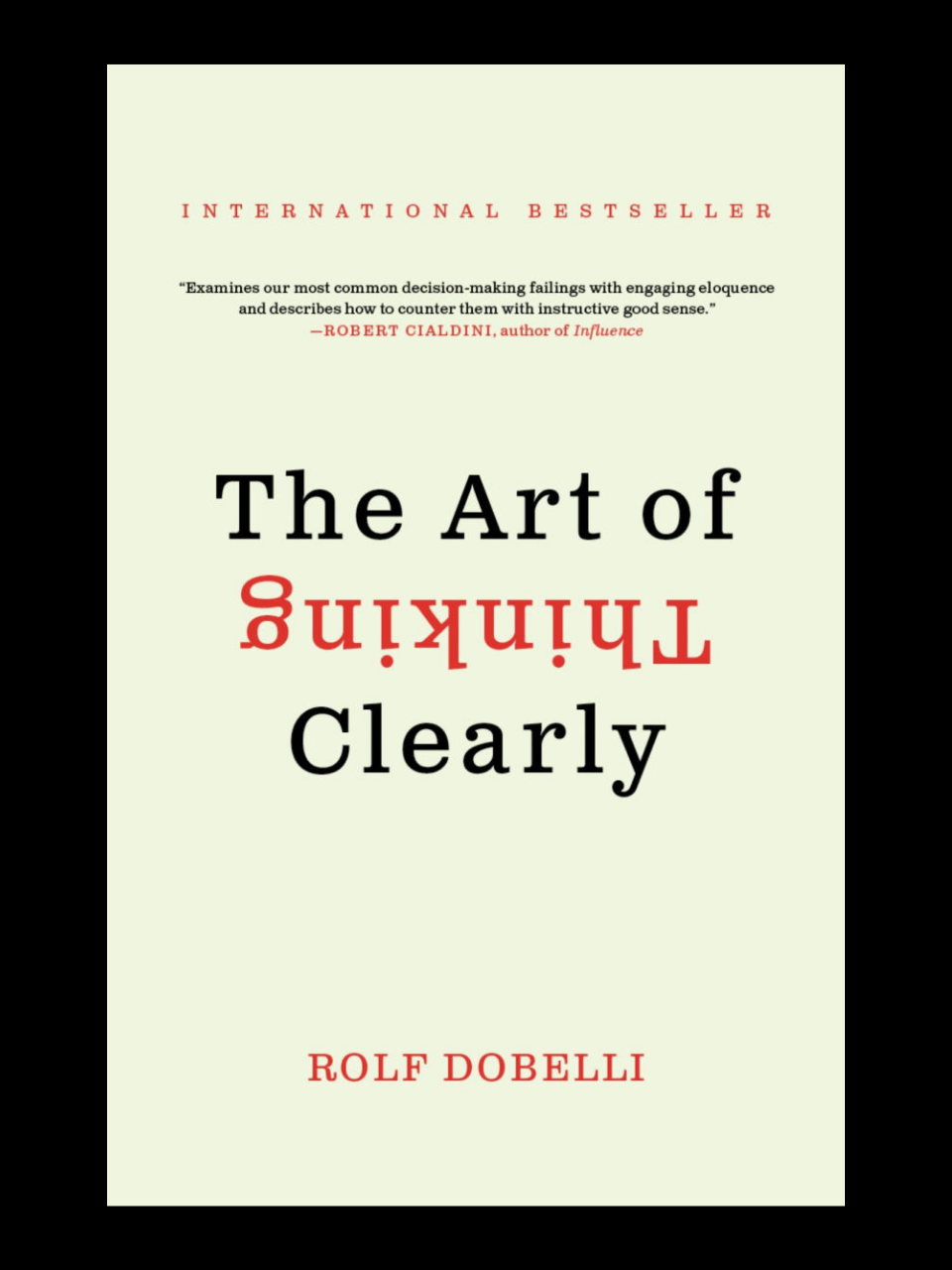
The Art Of Thinking Clearly By Rolf Dobelli
VAT exclusive · Delivery calculated at checkout
Master Your Decisions and Avoid Mental Traps with The Art of Thinking Clearly by Rolf Dobelli
The Art of Thinking Clearly by Rolf Dobelli opens with a liberating premise: we are all guilty of cognitive biases—simple errors we make in day-to-day thinking that systematically lead us astray. From why you should never accept a free drink to why you should walk out of a movie you don’t enjoy, from why it’s so hard to predict the future to why you should stop watching the news, this indispensable book helps solve the puzzle of human reasoning.
The fundamental idea at the heart of The Art of Thinking Clearly by Rolf Dobelli is that to lead happier, more prosperous lives, we don’t need extra cunning, new ideas, shiny gadgets, or more frantic activity—all we need is less irrationality. By understanding the predictable errors that mar our thinking, we can learn to recognize them in ourselves and take steps to minimize their influence. The book does not promise to eliminate these biases—they are far too ingrained for that—but it does offer the tools to identify them and make better choices despite their presence.
For ambitious Cameroonians navigating the complex decision-making landscapes of Douala, Yaoundé, Buea, Bamenda, and Limbe, The Art of Thinking Clearly by Rolf Dobelli provides an indispensable guide for anyone who wants to think more clearly, decide more wisely, and avoid the mental pitfalls that trip up even the most intelligent among us.
About the Author Rolf Dobelli: Why His Wisdom Matters in The Art of Thinking Clearly by Rolf Dobelli
Readers of The Art of Thinking Clearly by Rolf Dobelli benefit from the insights of a true Renaissance thinker. Rolf Dobelli, born in 1966, is a Swiss writer, novelist, and entrepreneur who holds both an MBA and a PhD in economic philosophy from the University of St. Gallen, Switzerland. This unique combination of business acumen and philosophical training gives him a distinctive perspective on how we think and decide.
Dobelli is also the co-founder of getAbstract, the world’s leading provider of book summaries, and the founder and curator of WORLD.MINDS (formerly Zurich Minds) is an invitation-only community of the world’s most distinguished thinkers, scientists, and artists. His work has been recognized globally, and The Art of Thinking Clearly by Rolf Dobelli became an instant success, landing at number one on Germany’s official bestseller list and remaining there for 80 consecutive weeks. When you read this book, you are learning from a man who has dedicated his life to distilling complex knowledge into accessible wisdom.
What You Will Discover in The Art of Thinking Clearly by Rolf Dobelli
The Art of Thinking Clearly by Rolf Dobelli is organized into 99 short chapters, each covering a single cognitive bias, thinking error, or fallacy. This structure makes the book perfect for reading in small doses, allowing each concept to sink in before moving to the next. The book draws on the work of giants in the field, including Daniel Kahneman, Amos Tversky, and Nassim Nicholas Taleb, translating their complex research into clear, practical guidance.
Perception and Reality
Confirmation bias, which Dobelli calls “the mother of all misconceptions,” is our tendency to interpret new information so that it becomes compatible with our existing theories, beliefs, and convictions. We filter out any new information that contradicts our existing views. Whether we believe people are inherently good or inherently bad, we will find daily proof to support our case.
Availability bias leads us to prefer wrong information to no information, systematically overestimating risks like being the victim of a plane crash while underestimating the risk of dying from diabetes, simply because the former receives more media attention.
The salience effect ensures that outstanding features of an event receive much more attention than they deserve, influencing not only how we interpret the past but also how we imagine the future.
Success and Failure
Survivorship bias causes us to systematically overestimate our chances of succeeding because triumph is made more visible than failure. We look at successful entrepreneurs and think we can do the same, overlooking the vast graveyard of failed ventures that never made the news.
The swimmer’s body illusion occurs when we confuse selection factors with results. Elite swimmers have perfect bodies, not because they swim so much, but because their genetics made them suited to the sport in the first place. We see correlation and assume causation, leading us to mimic behaviors that had nothing to do with success.
The hindsight bias makes us believe we are better predictors than we actually are, causing us to be arrogant about our knowledge and consequently to take too many risks. After an event, we convince ourselves we knew it all along.
The Problem with Teams
Social proof and groupthink illustrate how groups can undermine individual rationality. When everyone in a team seems to agree, it takes enormous courage to voice dissent. This is why Dobelli warns against the dangers of consensus in organizational settings.
Social loafing occurs when individual team members minimize their efforts while relying on others to pick up the slack, a form of cheating that can undermine team performance.
When We Cling to the Past
The sunk cost fallacy traps us into continuing projects simply because we have already invested time, money, or effort, even when prospects are dim. “We’ve invested so much money in it,” decision-makers argue. “If we stop now, it’ll all be for nothing.” This is irrational—only future costs and benefits should matter.
Effort justification leads us to overvalue results when we have put significant energy into a task. We convince ourselves that anything requiring hard work must be worthwhile.
The Illusion of Control
The illusion of control is the tendency to believe we can influence things over which we have absolutely no sway. Dobelli advises focusing on a few things of real importance that we can actually influence, rather than imagining ourselves masters of our fate like Roman emperors.
The paradox of choice reveals that abundance makes us giddy, but when it exceeds a certain limit, a surfeit of choices destroys the quality of life. More options do not lead to better decisions; they lead to decision paralysis and regret.
Key Concepts from The Art of Thinking Clearly by Rolf Dobelli
Chauffeur Knowledge vs. Real Knowledge
One of the most powerful distinctions in The Art of Thinking Clearly by Rolf Dobelli is between two types of knowledge. First, we have real knowledge, seen in people who have committed a large amount of time and effort to truly understand a topic. Second, we have chauffeur knowledge—knowledge from people who have learned to put on a show, reeling off eloquent words as if reading from a script, but lacking genuine depth. Recognizing the difference can save us from being misled by confident-sounding but shallow experts.
The Importance of Decision Processes
Dobelli emphasizes that we should never judge a decision purely by its result, especially when randomness and external factors play a role. A bad result does not automatically indicate a bad decision, and vice versa. Rather than tearing your hair out over a wrong outcome or applauding yourself for one that may have only coincidentally led to success, focus on the quality of the decision-making process itself.
Exponential Growth and Our Stone Age Brains
Our ancestors’ experiences were mostly linear—spend twice the time collecting berries and you get double the amount. We have no intuitive grasp of exponential growth because we didn’t need it in the Stone Age. Today, however, understanding exponential processes is essential for everything from investing to planning for the future.
The Power of “Because”
When justifying your behavior, simply using the word “because” increases tolerance and helpfulness, regardless of whether the excuse is actually good. This small insight reveals how our brains are wired to respond to certain cues, whether or not they make rational sense.
Decision Fatigue
Willpower is like a battery—after a while, it runs out and needs to be recharged. As a consumer, you become more susceptible to advertising messages and impulse buys when mentally depleted. As a decision-maker, you are more prone to poor judgments. Recognizing this, we can structure our days to make important decisions when our mental energy is at its peak.
Risk vs. Uncertainty
Risk means that probabilities are known; uncertainty means that probabilities are unknown. You can make calculations with risks, but not with uncertainty. This crucial distinction, drawn from the work of Frank Knight and Nassim Taleb, helps us understand when we can confidently decide and when we must acknowledge the limits of our knowledge.
What Readers Are Saying About The Art of Thinking Clearly by Rolf Dobelli
The Art of Thinking Clearly by Rolf Dobelli has earned extraordinary praise from readers and critics worldwide. It hit the number one spot on Germany’s official bestseller list and remained there for 80 consecutive weeks. The book became a top ten bestseller in the United Kingdom, South Korea, India, Ireland, Singapore, and Iran, demonstrating its universal appeal across cultures.
Critics have praised the book for its accessibility and practical wisdom. A starred review in Booklist called it “a fascinating book” and “a well-considered treatise on avoiding ‘self-induced unhappiness'”. The Times named it a bestseller, and the book has been translated into more than 40 languages.
Readers consistently note that the book’s short chapter format makes complex psychological concepts easy to digest and remember. As one reviewer noted, Dobelli’s approach “helps solve the puzzle of human reasoning” in a way that is “simple, clear, and always surprising” .
Why The Art of Thinking Clearly by Rolf Dobelli Matters for Cameroonians
The Art of Thinking Clearly by Rolf Dobelli arrives at a crucial moment for Cameroon’s professional and personal development communities. In our increasingly complex world, the ability to make sound decisions—free from the cognitive biases that trip us all—has never been more valuable.
Whether you are:
-
An entrepreneur in Douala is negotiating contracts and needs to recognize when biases cloud their judgment
-
A professional in Yaoundé is evaluating investment opportunities and wants to avoid the sunk cost fallacy
-
A student in Buea is learning to think critically and question their own assumptions
-
A business owner in Bamenda leading teams and needing to recognize groupthink before it undermines their decisions
-
A parent in Limbe is making important family decisions and wants to choose wisely
-
Anyone who has ever wondered why smart people make such foolish mistakes
The Art of Thinking Clearly by Rolf Dobelli provides the essential framework for recognizing the mental traps that await us all and developing the habits of mind that lead to better decisions.
Practical Wisdom You Can Apply Today
Pause Before Deciding
When facing an important decision, take a moment to ask yourself which biases might be at play. Are you falling for confirmation bias, seeking only information that supports your existing view? Are you influenced by the availability of vivid examples rather than true probabilities?
Seek Disconfirming Evidence
Actively look for information that challenges your beliefs. This is the antidote to confirmation bias and one of the most powerful tools for clear thinking.
Focus on Process, Not Outcomes
Judges’ decisions are based on the quality of the thinking behind them, not on results that may have been influenced by luck. This frees you from the tyranny of hindsight bias.
Beware the Sunk Cost Fallacy
When evaluating whether to continue a project, ask yourself only one question: knowing what I know now, would I start this today? If the answer is no, it is time to stop—regardless of what you have already invested.
Create Decision-Making Systems
Design your environment to compensate for your biases. Make important decisions when you are fresh, not fatigued. Seek diverse perspectives before concluding. Build in safeguards that force you to question your assumptions.
Your Journey with The Art of Thinking Clearly by Rolf Dobelli Starts Here
Imagine waking each day with greater clarity about the mental traps that once led you astray. Imagine making decisions with confidence, knowing that you have learned to recognize the biases that cloud others’ judgment. Imagine the freedom that comes from thinking clearly in a world designed to keep us confused.
This is the transformation that The Art of Thinking Clearly by Rolf Dobelli offers to every reader who commits to its wisdom.
FAQ:
1. What exactly is The Art of Thinking Clearly by Rolf Dobelli about?
The Art of Thinking Clearly by Rolf Dobelli is a practical guide to recognizing and avoiding the cognitive biases and thinking errors that lead to irrational decisions. It presents 99 short chapters, each explaining a specific mental trap—from confirmation bias to the sunk cost fallacy—with real-world examples and clear takeaways.
2. Who is Rolf Dobelli, the author of The Art of Thinking Clearly?
Rolf Dobelli is a Swiss writer, novelist, and entrepreneur with an MBA and a PhD in economic philosophy from the University of St. Gallen, Switzerland. He is the co-founder of getAbstract and the founder of WORLD.MINDS, a community of distinguished thinkers, scientists, and artists.
3. How is The Art of Thinking Clearly by Rolf Dobelli structured?
The book is organized into 99 short chapters, each covering a single cognitive bias, thinking error, or fallacy. This structure makes it perfect for reading in small doses, allowing each concept to be absorbed before moving to the next.
4. What are some of the cognitive biases covered in the book?
The book covers a wide range of biases, including confirmation bias (interpreting information to fit existing beliefs), availability bias (overestimating vivid risks), survivorship bias (focusing on success stories while ignoring failures), the sunk cost fallacy (continuing failed projects because of past investment), and many others.
5. How quickly can I get The Art of Thinking Clearly by Rolf Dobelli delivered in Cameroon?
We offer fast and reliable delivery throughout Cameroon. If you reside in major cities such as Douala, Yaoundé, Buea, Bamenda, or Limbe, you can expect your order within 24 to 72 hours. Deliveries to other locations are also impressively swift.
6. What payment methods do you accept for The Art of Thinking Clearly by Rolf Dobelli?
For your convenience, we accept all major bank cards as well as popular local options, including Orange Money and MTN Mobile Money at checkout.
7. How long is The Art of Thinking Clearly by Rolf Dobelli?
The Art of Thinking Clearly by Rolf Dobelli is approximately 303 to 358 pages, depending on the edition. It includes bibliographical references for readers who wish to explore the original research further.
8. When was The Art of Thinking Clearly by Rolf Dobelli first published?
The book was first published in 2013, with earlier German editions appearing in 2011. It has since been translated into more than 40 languages and has sold over three million copies worldwide.
9. Is The Art of Thinking Clearly by Rolf Dobelli suitable for someone new to psychology?
Yes, absolutely. The book is written for general readers and requires no background in psychology or behavioral economics. It distills complex research into clear, engaging, and immediately applicable insights.
10. Who would benefit most from reading The Art of Thinking Clearly by Rolf Dobelli?
Entrepreneurs, business leaders, professionals, students, and anyone who makes decisions—which is to say, everyone—will benefit from this book. It is particularly valuable for those who want to understand why they make the choices they do and how to make better ones in the future.
Ready to master the art of clear thinking and make better decisions with The Art of Thinking Clearly by Rolf Dobelli?
You do not have to remain at the mercy of mental traps that cloud your judgment. The systematic guide to recognizing and avoiding cognitive biases—distilled from decades of research and presented in 99 unforgettable chapters—awaits you within these pages.
Join millions of readers worldwide who have discovered the transformative power of Rolf Dobelli’s practical wisdom. Secure your copy of The Art of Thinking Clearly by Rolf Dobelli today and begin the journey to clearer thinking, wiser decisions, and a life with less irrationality.
Remember: “We don’t need extra cunning, new ideas, shiny gadgets, or more frantic activity—all we need is less irrationality”. Start thinking clearly today.
You might also like


Reviews
There are no reviews yet.