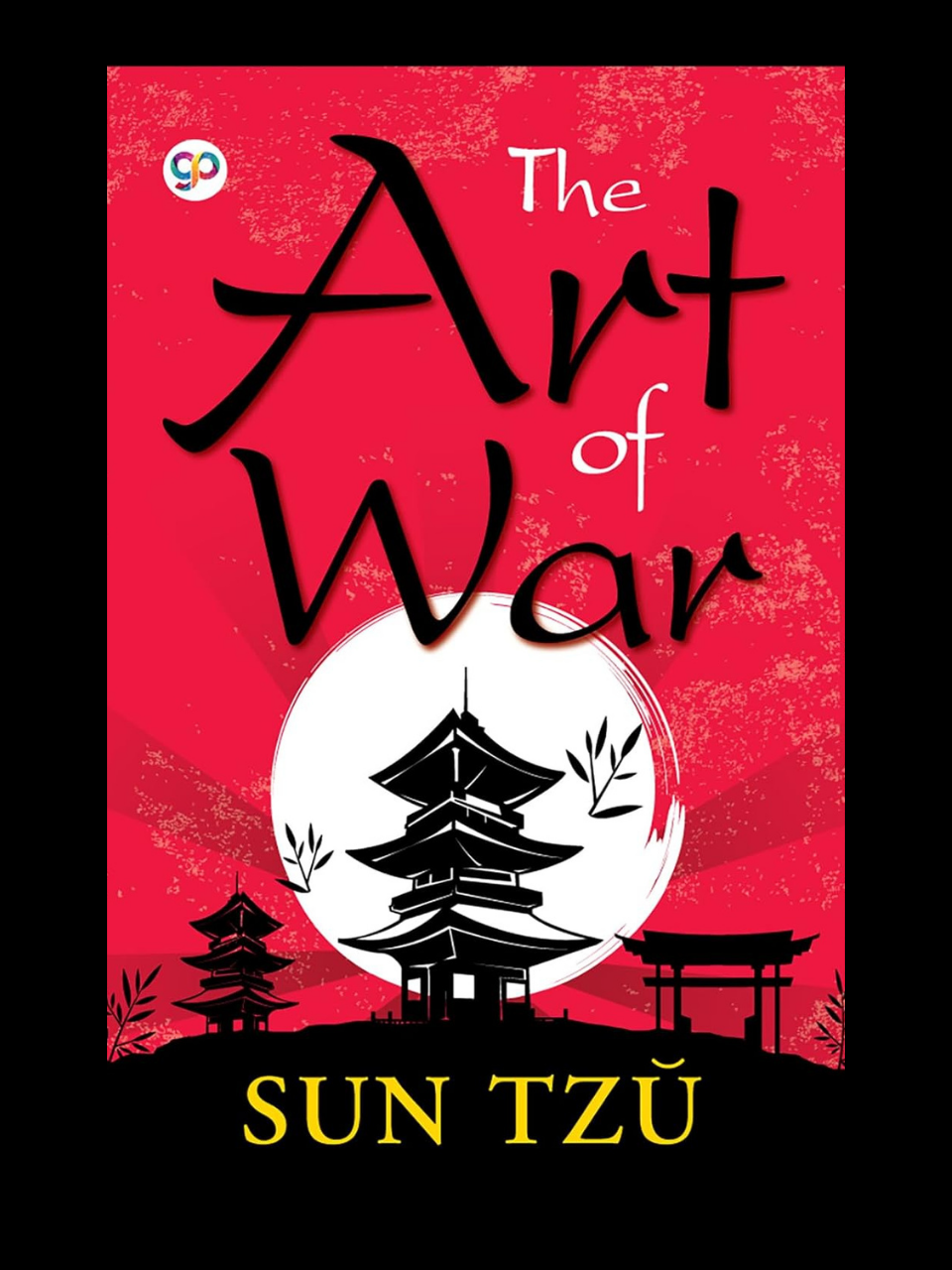
The Art Of War By Sun Tzu
VAT exclusive · Delivery calculated at checkout
Master the Timeless Principles of Strategy with The Art of War by Sun Tzu
The Art of War by Sun Tzu is far more than an ancient military manual; it is a philosophical masterpiece whose profound insights have shaped the thinking of leaders for over two millennia. Attributed to Sun Tzu, a high-ranking Chinese general and strategist who lived during the tumultuous Warring States Period (roughly the 5th century BC), this classic work remains the most important strategic text in East Asian warfare and has profoundly influenced both Eastern and Western military thinking, business tactics, legal strategy, and beyond.
The fundamental idea at the heart of The Art of War by Sun Tzu is simple yet revolutionary: the supreme art of war is to subdue the enemy without fighting. For Sun Tzu, strategy is not about brute force but about outthinking, outmaneuvering, and outlasting one’s opponent through careful planning, deep self-knowledge, and masterful deception. His most famous axiom, “Know the enemy and know yourself, and you can fight a hundred battles with no danger of defeat,” encapsulates a philosophy that applies as readily to boardroom negotiations as it does to battlefield commands.
For ambitious Cameroonians navigating the competitive landscapes of Douala, Yaoundé, Buea, Bamenda, and Limbe, the wisdom Sun Tzu shares in The Art of War by Sun Tzu provides an essential framework for understanding conflict, competition, and the path to victory in any endeavor.
About the Author Sun Tzu: Why His Wisdom Matters in The Art of War by Sun Tzu
Readers of The Art of War by Sun Tzu encounter a figure shrouded in legend yet whose influence is undeniably real. Sun Tzu, also known as Sunzi or Sun Wu, was an ancient Chinese general and philosopher who lived during the latter part of the Spring and Autumn Period. His given military name, “Sun Tzu,” translates as “Master Sun” and was likely an honorific title. While scholars debate the exact details of his life and whether he personally authored every word of the text attributed to him, his profound insight into military strategy and expert leadership earned him a revered place in history as one of the greatest military generals of all time.
According to tradition, Sun Tzu’s brilliance was first recognized by King Ho Lu of Wu, who asked him to demonstrate his theories by training an army of 180 court ladies. When the women laughed at his initial commands, Sun Tzu explained that unclear orders are the general’s fault. He repeated the instructions, and when the women laughed again, he ordered the execution of the two lead concubines despite the King’s protests. Thereafter, the remaining women obeyed without error, proving that clear communication and consistent discipline are the foundations of effective leadership. This story, recounted in historical texts, illustrates the unwavering principles that permeate The Art of War by Sun Tzu.
The Thirteen Chapters of The Art of War by Sun Tzu
The Art of War by Sun Tzu is organized into thirteen concise chapters, each devoted to a distinct aspect of warfare and strategy. Together, they form a logical and comprehensive guide to conflict and competition.
Chapter I: Laying Plans
The opening chapter of The Art of War by Sun Tzu establishes the critical importance of careful calculation before any engagement. Sun Tzu declares that the art of war is of vital importance to the state—a matter of life and death, a road either to safety or to ruin, which can on no account be neglected. He identifies five fundamental factors that must guide all strategic deliberations: the Moral Law (causing the people to be in complete accord with their ruler), Heaven (the seasons and conditions), Earth (terrain and distance), the Commander (wisdom, sincerity, benevolence, courage, and strictness), and Method and Discipline (organization and logistics). By comparing these factors with those of one’s opponent, victory or defeat can be forecast. Perhaps most famously, Sun Tzu declares that “all warfare is based on deception” —appearing unable when able, inactive when active, and far away when near.
Chapter II: Waging War
In this chapter, Sun Tzu addresses the immense costs of prolonged conflict. He argues that there is no instance of a country having benefited from prolonged warfare and counsels that victory should be the great object, not lengthy campaigns. He advises foraging on the enemy to conserve one’s own resources and emphasizes that captured soldiers should be treated kindly and incorporated into one’s own forces—” using the conquered foe to augment one’s own strength”.
Chapter III: Attack by Stratagem
This chapter contains some of the most celebrated passages in The Art of War by Sun Tzu. Sun Tzu states that supreme excellence consists not in winning every battle fought, but in breaking the enemy’s resistance without fighting at all. The highest form of generalship is to baulk the enemy’s plans; the next best is to prevent the junction of his forces; the next is to attack his army in the field; and the worst policy is to besiege walled cities. He provides practical guidelines for engagement based on relative strength: if ten times the enemy’s numbers, surround him; if five times, attack; if equal, offer battle; if slightly inferior, avoid him; if completely unequal, flee. The chapter concludes with the timeless axiom: “If you know the enemy and know yourself, you need not fear the result of a hundred battles”.
Chapter IV: Tactical Dispositions
Sun Tzu teaches that to secure ourselves against defeat lies in our own hands, but the opportunity of defeating the enemy is provided by the enemy himself. True excellence is not to fight and conquer, but to plan secretly, move surreptitiously, and foil the enemy’s intentions so that the day may be won without shedding a drop of blood.
Chapter V: Energy
Energy, Sun Tzu explains, comes from a combination of resources and indirect tactics. It may be likened to the bending of a crossbow; decision, to the releasing of the trigger. The onset of troops should be like the rush of a torrent that will roll stones along in its course.
Chapter VI: Weak Points and Strong
This chapter emphasizes the importance of maneuvering against an opponent, avoiding his strengths, and staying flexible. By remaining subtle and secretive, one can ensure that the enemy does not know where to defend, and by seeking the enemy’s weakness while concealing one’s own, victory becomes attainable.
Chapter VII: Maneuvering
Sun Tzu provides practical guidance on moving armies effectively, noting that we are not fit to lead an army on the march unless we are familiar with the face of the country—its mountains, forests, pitfalls, and marshes. He advises against interfering with an army that is returning home, as men whose hearts are set on returning will fight to the death, and counsels that when surrounding an army, one should leave an outlet free.
Chapter VIII: Variation of Tactics
Flexibility is the key theme of this chapter. Sun Tzu observes that there are armies that must not be attacked, positions that must not be contested, and commands of the sovereign that must not be obeyed. He also identifies five dangerous faults that can affect a general: recklessness, cowardice, a hasty temper, delicacy of honor, and over-solicitude for his men.
Chapter IX: The Army on the March
This chapter provides detailed observations on reading the enemy’s intentions through terrain, troop movements, and natural signs. Sun Tzu emphasizes that he who exercises no forethought but makes light of his opponents is sure to be captured.
Chapter X: Classification of Terrain
Sun Tzu classifies various types of terrain—accessible, entangling, temporizing, narrow passes, precipitous heights, and positions at a great distance from the enemy—and explains how each should be handled. He also identifies calamities due to errors in generalship and outlines the tests of good generalship.
Chapter XI: The Nine Situations
This lengthy chapter describes nine distinct tactical situations a commander may encounter, from dispersive ground where a warlike state cannot be created to deadly ground where only desperate fighting can lead to survival. Sun Tzu explains how to adapt strategy to each situation and emphasizes the importance of courage, secrecy, and swift decision-making when deep in hostile territory.
Chapter XII: Attack by Fire
Sun Tzu discusses the use of fire as a weapon, identifying five methods of attacking with fire and the appropriate circumstances for each. He also mentions the use of water as an auxiliary means of attack.
Chapter XIII: Use of Spies
The final chapter of The Art of War by Sun Tzu addresses the critical importance of intelligence. Sun Tzu argues that what enables the wise sovereign and good general to strike and conquer is foreknowledge, which cannot be elicited from spirits or gods, nor by analogy with past events, nor from calculations—it must be obtained from people who know the enemy’s situation. He classifies five types of spies and explains how to use them effectively, concluding that it is essential to seek out enemy agents who have come to spy and bribe them to serve one’s own purposes.
Key Themes in The Art of War by Sun Tzu
The Primacy of Strategy over Brute Force
Throughout The Art of War by Sun Tzu, a central theme emerges: the highest form of victory is achieved without fighting at all. Strategic brilliance, not sheer force, is the path to lasting success. This principle has profound applications in business, politics, and personal life.
The Importance of Self-Knowledge and Knowledge of Others
Sun Tzu’s most famous axiom—”know the enemy and know yourself”—emphasizes that genuine understanding is the foundation of all successful strategy. By assessing one’s own strengths and weaknesses alongside those of one’s opponent, one can anticipate outcomes and act with confidence.
The Art of Deception and Surprise
Sun Tzu teaches that “all warfare is based on deception”. Appearing weak when strong, near when far, and inactive when active keeps opponents off balance and creates opportunities for victory. This principle underscores the importance of unpredictability in competitive situations.
Flexibility and Adaptation
Sun Tzu repeatedly emphasizes that strategy must adapt to circumstances. There are no fixed rules that apply in all situations; the skillful leader varies tactics according to terrain, enemy disposition, and changing conditions. This flexibility is the hallmark of true strategic mastery.
The Moral and Human Dimensions of Leadership
Sun Tzu identifies the Commander as one of the five fundamental factors in war, requiring wisdom, sincerity, benevolence, courage, and strictness. He also emphasizes the importance of treating soldiers humanely and maintaining their morale, recognizing that victory depends ultimately on the commitment and effort of people.
The Enduring Relevance of The Art of War by Sun Tzu
The Art of War by Sun Tzu has transcended its origins as a military manual to become a guide for strategy in virtually every field of human endeavor. Preserved in China for more than two thousand years before being brought to the West by French missionaries in the late 18th century, it has been studied by military leaders from Napoleon to General Schwarzkopf.
In the twentieth century, its influence expanded dramatically. American officers read it closely during World War II. The Japanese army studied the work for decades, and many Chinese officers were said to know the book by heart. More recently, it has been embraced by business leaders, corporate executives, and entrepreneurs who find valuable insights for competing successfully in the marketplace. It has also been applied to sports, law, diplomacy, and personal development.
As the Alexander Hamilton Society notes, The Art of War by Sun Tzu introduces “the value of looking to ancient or historical texts to find timeless insights into strategy.” Its principles remain as pertinent today as when they were written over two millennia ago.
What Readers Are Saying About The Art of War by Sun Tzu
The Art of War by Sun Tzu has earned its reputation as one of the most influential books ever written. A Google Books review describes it as “a lucid epigrammatic text that reveals as much about human psychology, politics, and economics as it does about battlefield strategy” .The influence of Sun Tzu’s text has grown tremendously in the West in recent years, with military leaders, politicians, and corporate executives alike finding valuable insight in these ancient words.
Readers consistently praise the book’s timeless wisdom and its applicability to modern challenges. One reviewer notes that the work is “a valuable guide to competing successfully in business,” stressing the importance of attacking when your enemy is unprepared, scheming to discover his plans, avoiding the strong and striking at the weak, and using intelligence for every kind of operation.
Another reader observes that The Art of War by Sun Tzu is “a profound meditation on human psychology, interrogating the subjects of leadership, self-discipline and self-awareness”. This psychological depth, combined with its practical strategic guidance, makes it an endlessly rewarding read.
Why The Art of War by Sun Tzu Matters for Cameroonians
The Art of War by Sun Tzu arrives at a crucial moment for Cameroon’s professional, entrepreneurial, and personal development communities. In our increasingly competitive and complex world, the ability to think strategically, understand opponents, and adapt to changing circumstances is more valuable than ever.
Whether you are:
-
An entrepreneur in Douala is facing intense competition and needs to outmaneuver rivals
-
A business leader in Yaoundé seeking to develop organizational strategy and build a competitive advantage
-
A negotiator in Buea wants to understand the hidden dynamics of high-stakes conversations
-
A student in Bamenda studying leadership, strategy, or international relations
-
A professional in Limbe is navigating office politics and seeking to advance their career
-
Anyone who has ever faced a seemingly insurmountable opponent and wondered how to prevail
The Art of War by Sun Tzu provides the strategic framework and timeless wisdom you need to assess situations clearly, choose your battles wisely, and act with confidence and precision.
Practical Applications of The Art of War by Sun Tzu
From the pages of The Art of War by Sun Tzu, here are principles you can apply to your own challenges:
-
Know yourself and know your competition. Before entering any competitive situation, thoroughly assess your own strengths and weaknesses alongside those of your opponent. This self-knowledge is the foundation of all successful strategy.
-
Choose your battles wisely. Sun Tzu teaches that supreme excellence consists in breaking the enemy’s resistance without fighting. Avoid unnecessary conflict and seek to achieve your objectives through superior positioning and strategy rather than confrontation.
-
Be flexible and adapt. There are no fixed rules that apply in all situations. Adjust your approach based on changing circumstances, terrain, and the disposition of your opponent.
-
Use deception strategically. Appear weak when strong, near when far, and inactive when active. Keeping opponents uncertain of your intentions creates opportunities for advantage.
-
Prepare thoroughly before acting. The general who wins a battle makes many calculations in his temple before the battle is fought. Careful planning and preparation are essential to success.
-
Treat your team well. Sun Tzu emphasizes the importance of benevolence and care for those who follow you. Loyal and motivated teams are essential to achieving any ambitious goal.
-
Gather intelligence continuously. Foreknowledge cannot be obtained from spirits or calculations—it must be obtained from people who know the situation. Invest in understanding your environment and the people within it.
Your Journey with The Art of War by Sun Tzu Starts Here
Imagine approaching every challenge with the strategic clarity of an ancient Chinese general. Imagine understanding your competitors so deeply that you can anticipate their moves and counter them before they unfold. Imagine navigating life’s battles with the calm confidence that comes from knowing you have prepared thoroughly and see the situation clearly.
This is the transformation that The Art of War by Sun Tzu offers to every reader who studies its pages and applies its principles.
FAQ:
1. What exactly is The Art of War by Sun Tzu about?
The Art of War by Sun Tzu is an ancient Chinese military treatise dating from roughly the 5th century BC. It is composed of thirteen chapters, each devoted to an aspect of warfare, including laying plans, waging war, attack by stratagem, tactical dispositions, energy, weak points and strong points, maneuvering, variation of tactics, the army on the march, classification of terrain, the nine situations, attack by fire, and the use of spies. The work provides timeless insight and wisdom into military command and strategy.
2. Who was Sun Tzu, the author of The Art of War?
Sun Tzu, also known as Sunzi or Sun Wu, was an ancient Chinese general and philosopher who lived during the latter part of the Spring and Autumn Period. His given military name, “Sun Tzu,” translates as “Master Sun” and was likely an honorific title. He is revered as one of the greatest military generals of all time.
3. How is The Art of War by Sun Tzu relevant today?
While originally a military text, The Art of War by Sun Tzu is now considered an essential guide for business, law, politics, sports, and personal success. The principles of strategy, planning, and understanding one’s opponent apply universally to any competitive endeavor.
4. What are the most famous quotes from The Art of War by Sun Tzu?
The most famous and often-quoted passage is: “Know the enemy and know yourself, and you can fight a hundred battles with no danger of defeat”. Other celebrated axioms include “All warfare is based on deception” and “Supreme excellence consists in breaking the enemy’s resistance without fighting”.
5. How quickly can I get The Art of War by Sun Tzu delivered in Cameroon?
We offer fast and reliable delivery throughout Cameroon. If you reside in major cities such as Douala, Yaoundé, Buea, Bamenda, or Limbe, you can expect your order within 24 to 72 hours. Deliveries to other locations are also impressively swift.
6. What payment methods do you accept for The Art of War by Sun Tzu?
For your convenience, we accept all major bank cards as well as popular local options, including Orange Money and MTN Mobile Money, at checkout. We strive to make acquiring this essential book by Sun Tzu as seamless as possible.
7. How long is The Art of War by Sun Tzu?
The Art of War by Sun Tzu is a concise work, typically ranging from approximately 92 to 176 pages depending on the edition and accompanying commentary. The core text is brief but dense, rewarding repeated study.
8. Which translation of The Art of War by Sun Tzu is best?
Numerous translations exist, with the Lionel Giles translation (1910) being one of the most widely available and respected. The John Minford translation is also highly regarded. We offer quality editions that make this ancient text accessible to modern readers.
9. Is The Art of War by Sun Tzu difficult to read?
The text itself is composed of beautifully succinct proverbs and adages that are quite readable. However, the depth of meaning rewards careful study and reflection. Many editions include commentary and historical context to aid understanding.
10. Who would benefit most from reading The Art of War by Sun Tzu?
Anyone interested in strategy, competition, leadership, or personal development will benefit from this book. Military personnel, business executives, entrepreneurs, students of political science, athletes, and anyone seeking to understand the dynamics of conflict and competition will find its wisdom invaluable.
Ready to master the timeless principles of strategy with The Art of War by Sun Tzu?
You do not have to face your battles unprepared. The strategic wisdom that has guided generals, emperors, and business leaders for over two thousand years awaits you within these pages.
Join millions of readers worldwide who have discovered the power of Sun Tzu’s profound insights. Secure your copy of The Art of War by Sun Tzu today and begin the journey to mastering the art of strategy, understanding your opponents, and achieving victory in all your endeavors.
Remember: Know the enemy and know yourself, and you can fight a hundred battles with no danger of defeat. Start your journey to mastery now.
You might also like

Reviews
There are no reviews yet.