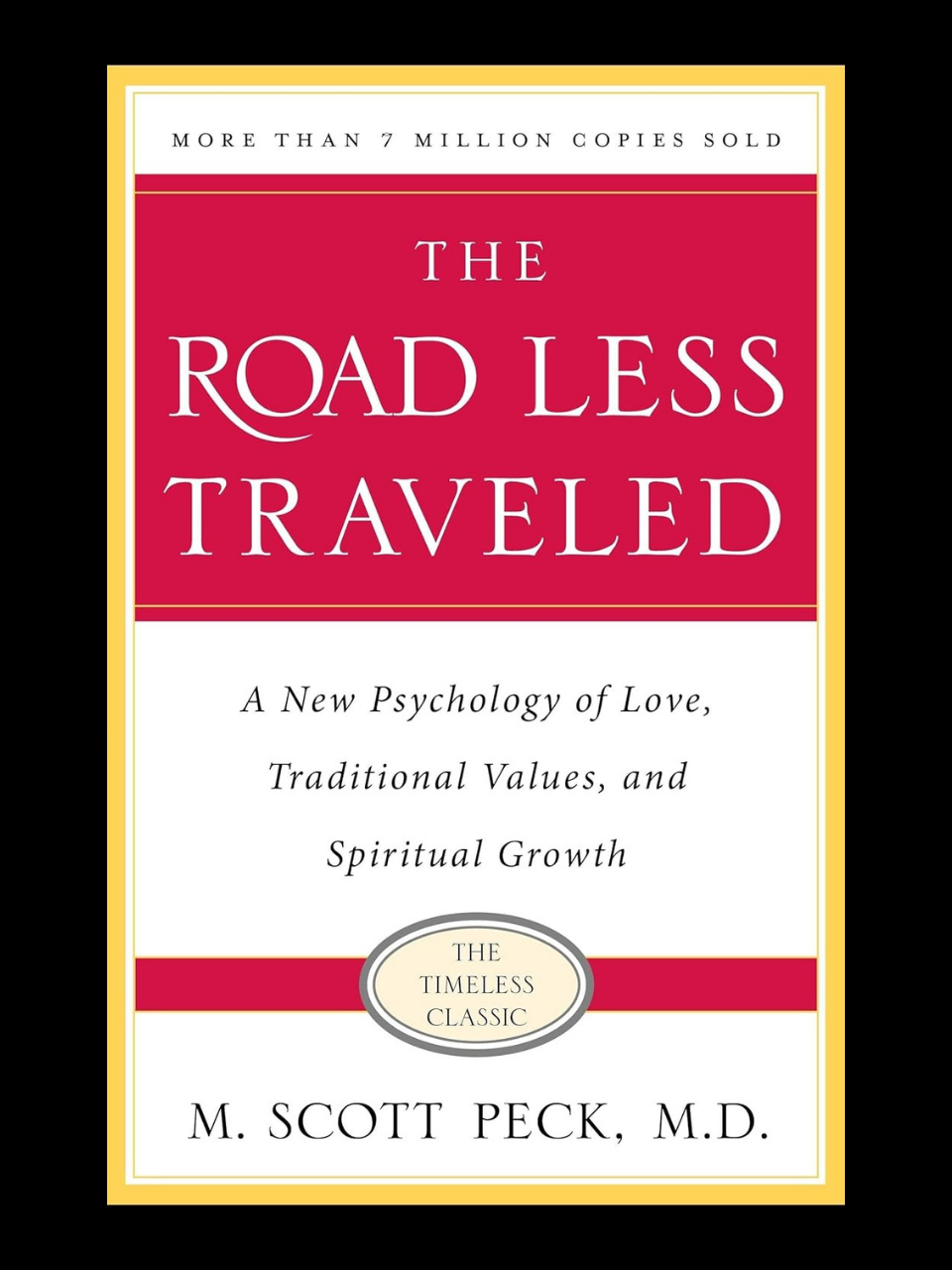
The Road Less Traveled By M. Scott Peck
VAT exclusive · Delivery calculated at checkout
Embrace the Path to Authentic Living with The Road Less Traveled by M. Scott Peck
The Road Less Traveled by M. Scott Peck opens with one of the most memorable and disarming first lines in all of literature: “Life is difficult”. This simple declaration, far from being pessimistic, forms the foundation of a revolutionary approach to personal growth. Dr. Peck, a Harvard-educated psychiatrist with decades of clinical experience, argues that once we truly accept that life inherently involves struggle, we transcend that very difficulty and position ourselves for genuine transformation.
The fundamental idea at the heart of The Road Less Traveled by M. Scott Peck is that spiritual and psychological growth require us to embrace discipline, understand the true nature of love, and remain open to the grace that flows through our lives. Drawing on his extensive work with psychotherapy patients, Peck weaves together insights from Freudian and Jungian psychology with a deeply humane spiritual perspective, creating a work that defies easy categorization and speaks directly to the soul.
For ambitious Cameroonians navigating the dynamic landscapes of Douala, Yaoundé, Buea, Bamenda, and Limbe, The Road Less Traveled by M. Scott Peck provides an indispensable guide for those who sense that the easy path is not the meaningful one, and who are ready to undertake the courageous work of becoming fully human.
About the Author M. Scott Peck: Why His Voice Matters in The Road Less Traveled by M. Scott Peck
Readers of The Road Less Traveled by M. Scott Peck connect with an author whose life journey uniquely equipped him to write this transformative work. Morgan Scott Peck was born in New York City in 1936 and raised in a Protestant family with Quaker roots. His path to becoming one of the most influential psychiatrists of his generation was shaped by both academic rigor and profound personal experience.
Peck attended Harvard University, where he received his bachelor’s degree in 1958, and then earned his medical degree from Case Western Reserve University in 1963. He served in the United States Army for nearly a decade, rising to the rank of lieutenant colonel and holding positions including chief of psychology at the Army Medical Center in Okinawa, Japan. After his military service, he became the medical director of the New Milford Hospital Mental Health Clinic and maintained a private psychiatric practice in Connecticut.
The Road Less Traveled by M. Scott Peck was first published in 1978 after being turned down by Random House, which found the final section “too Christ-y”. Simon & Schuster published a modest hardback run of 5,000 copies, and the book gradually built its audience through Peck’s lectures and word-of-mouth recommendations. It first appeared on bestseller lists in 1984—six years after its initial publication—and has since sold more than ten million copies worldwide, translated into dozens of languages. When you read this book, you are learning from a psychiatrist whose clinical experience, personal struggles, and spiritual journey converged to create a work of lasting wisdom.
The Four-Part Journey of The Road Less Traveled by M. Scott Peck
The Road Less Traveled by M. Scott Peck is structured in four parts, each building upon the last to guide readers from self-discipline through love and religion to the ultimate mystery of grace.
Part I: Discipline
The book opens by establishing that life’s difficulties are not obstacles to be avoided but opportunities to be embraced. Peck identifies four tools of discipline that enable us to work through our problems and emerge stronger on the other side.
Delaying Gratification is the first and most fundamental discipline. Peck describes it as “a process of scheduling the pain and pleasure of life in such a way as to enhance the pleasure by meeting and experiencing the pain first and getting it over with”. This simple practice of facing the difficult before indulging in the pleasurable is the foundation of all mature living.
Acceptance of Responsibility requires us to acknowledge our role in creating our circumstances and our power to change them. Peck illustrates this through clinical examples of patients who remained trapped because they refused to take responsibility for their choices. The alcoholic who insisted there was nothing to do but drink, and the depressed woman who rejected every suggestion for connection, both remained stuck because they would not own their agency.
Dedication to Reality means committing to truth, however painful it may be. “We must always hold truth, as best we can determine it, to be more important, more vital to our self-interest, than our comfort,” Peck writes. This dedication requires constant self-examination and a willingness to have our cherished beliefs challenged.
Balancing is the art of reconciling conflicting demands. “To willingly confront a problem early, before we are forced to confront it by circumstances, means to put aside something pleasant or less painful for something more painful”. This capacity for wise discernment develops over a lifetime and is central to mental health.
Part II: Love
The second part of The Road Less Traveled by M. Scott Peck offers one of the most transformative definitions of love ever written. Peck argues that love is not a feeling but an action—”the will to extend one’s self for the purpose of nurturing one’s own or another’s spiritual growth”.
This definition demolishes common misconceptions about love. Romantic love, with its intoxicating feelings of falling, is exposed as a “very destructive myth” when relied upon as the foundation of relationships. Dependency, which masquerades as love, is revealed as a force that constricts and traps rather than liberates.
True love, Peck insists, is never passive. “Love is as love does”. It always requires effort, and more often than not, it requires courage. Love involves giving oneself and others what they need to grow, which sometimes means enduring conflict, enforcing boundaries, and making sacrifices.
Perhaps most challengingly, Peck argues that love is cyclical—loving others and loving oneself naturally begets love in return. This self-love is not selfishness but the foundation upon which all genuine relationships are built.
Part III: Growth and Religion
The third section of The Road Less Traveled by M. Scott Peck explores the role of belief systems in psychological health. Peck argues that everyone has a religion in the sense that everyone operates from a worldview that shapes their understanding of reality. Even atheists and agnostics have belief systems that serve religious functions.
Drawing on patient case histories, Peck demonstrates how unexamined religious assumptions can either hinder or accelerate spiritual growth. Some patients carry childhood images of God that keep them trapped in fear and guilt, while others discover through therapy a more mature faith that liberates them. This section invites readers to examine their own “maps” of reality and remain open to revising them as they grow.
Peck’s own spiritual journey evolved during the writing of this book. After years of vague identification with Buddhist and Islamic mysticism, he made a firm Christian commitment and was baptized in 1980. However, his approach remains accessible to readers of any faith or none, focusing on universal principles rather than dogmatic teachings.
Part IV: Grace
The final section of The Road Less Traveled by M. Scott Peck addresses the mysterious force that nurtures spiritual growth from beyond our conscious awareness. Peck calls this force “grace” and identifies it as operating through miracles of health, the unconscious, and serendipity.
These phenomena, Peck argues, share common characteristics: they nurture human life and spiritual growth, they are incompletely understood by scientific thinking, they are commonplace among humanity, and they originate outside the conscious human will. He concludes that “the miracles described indicate that our growth as human beings is being assisted by a force other than our conscious will”.
Attuning ourselves to grace requires the same attention we give to our intimate relationships. When we encounter instances of chance or serendipity, the universe—which can also be identified as the divine—is offering ancestral wisdom. By remaining alert to these moments, we open ourselves to assistance we could never provide for ourselves.
Key Concepts in The Road Less Traveled by M. Scott Peck
The Map of Reality
Peck introduces the powerful metaphor of the map with which we navigate the terrain of life. “If the map is true and accurate, we will generally know where we are, and if we have decided where we want to go, we will generally know how to get there. If the map is false and inaccurate, we generally will be lost”. The work of personal growth requires us to constantly revise our maps as we encounter new territory.
Neurotic Suffering vs. Legitimate Suffering
A crucial distinction in The Road Less Traveled by M. Scott Peck is between neurotic suffering and legitimate suffering . Neurotic suffering is the unnecessary pain we create by avoiding problems, refusing responsibility, and clinging to comfortable illusions. Legitimate suffering is the unavoidable pain of confronting life’s challenges honestly.
Peck quotes Carl Jung: “Neurosis is always a substitute for legitimate suffering” . Our aim must be to eliminate neurotic suffering by working through our legitimate suffering, thereby achieving our individual goals. “When we avoid the legitimate suffering that results from dealing with problems, we also avoid the growth that problems demand from us”.
The Will to Extend Oneself
Central to Peck’s understanding of love is the concept of will—desire of sufficient intensity that it is translated into action. “The difference between the two is equal to the difference between saying ‘I would like to go swimming tonight’ and ‘I will go swimming tonight'”. This distinction between passive wishing and active willing is essential for anyone committed to genuine growth.
What Readers Are Saying About The Road Less Traveled by M. Scott Peck
The Road Less Traveled by M. Scott Peck has earned passionate responses from readers across six continents. One reviewer in India describes it as “the book of life wisdom,” noting that “if there was one book, just one, to teach us the basics of how to live a life (and not just a living), it would be this book”.
A reader in the United Kingdom who first encountered the book in their twenties, struggling with depression, shares, “Over 30 years I’ve bought many copies of this book that I’ve given mainly to young people struggling with life and mental health, as it was a book that helped me the most… Most have said it’s really helped them”.
Another reader calls it “a timeless masterpiece” and “one of my all-time favorites”. A Canadian reviewer shares, “This book is amazing and healing. I have had a previous one and wore it out by reading it so often. Each time I read it, I get further Revelation”.
One reviewer captures the book’s enduring value: “This book is one deserving a second or a third read! The Road Less Traveled by M. Scott Peck is a book that I will read more than once, which is the highest compliment that I can give. It’s a spiritual and intellectual masterpiece”.
Some readers offer balanced perspectives, noting that the book can feel “clinical or overly anecdotal” and that Peck’s tone can “veer toward the paternalistic”. However, most agree that these minor flaws are outweighed by the book’s profound insights and lasting impact.
Why The Road Less Traveled by M. Scott Peck Matters for Cameroonians
The Road Less Traveled by M. Scott Peck arrives at a crucial moment for Cameroon’s personal and professional development communities. In our fast-paced world, the temptation to avoid difficulty, to take shortcuts, and to seek quick fixes is ever-present. Yet lasting fulfillment cannot be found on the easy path.
Whether you are:
-
An entrepreneur in Douala is facing the inevitable struggles of building a business and wondering if the difficulty means they are on the wrong path
-
A professional in Yaoundé navigating career challenges and seeking the discipline to grow through them
-
A student in Buea is learning to face academic and personal challenges with courage
-
A parent in Bamenda wants to model for their children that life’s difficulties are not obstacles but opportunities
-
A creative in Limbe is struggling with the discipline required to produce meaningful work
-
Anyone who has ever sensed that the easy path is not the right path for you
The Road Less Traveled by M. Scott Peck offers the compassionate yet demanding wisdom you need to embrace the journey, however difficult, and discover that it leads exactly where you need to go.
Memorable Quotations from The Road Less Traveled by M. Scott Peck
-
“Life is difficult. This is a great truth, one of the greatest truths. It is a great truth because once we truly see this truth, we transcend it”.
-
“Once we truly know that life is difficult—once we truly understand and accept it—then life is no longer difficult. Because once it is accepted, the fact that life is difficult no longer matters”.
-
“When we avoid the legitimate suffering that results from dealing with problems, we also avoid the growth that problems demand from us”.
-
“Delaying gratification is a process of scheduling the pain and pleasure of life in such a way as to enhance the pleasure by meeting and experiencing the pain first and getting it over with”.
-
“To willingly confront a problem early, before we are forced to confront it by circumstances, means to put aside something pleasant or less painful for something more painful”.
-
“We must accept responsibility for a problem before we can solve it”.
-
“Our view of reality is like a map with which to negotiate the terrain of life”.
-
“We must always hold truth, as best we can determine it, to be more important, more vital to our self-interest, than our comfort”.
-
“For all that is given up, even more is gained. Self-discipline is a self-enlarging process”.
-
“It is easy and not at all unpleasant to find evidence of love in one’s feelings. It may be difficult and painful to search for evidence of love in one’s actions”.
Your Journey with The Road Less Traveled by M. Scott Peck Starts Here
Imagine waking each day with the quiet confidence that you possess the discipline to face whatever arises. Imagine understanding love not as a feeling that comes and goes but as a choice you make, an action you take, a gift you give. Imagine being open to the grace that flows through your life, assisting you in ways you could never accomplish alone.
This is the transformation The Road Less Traveled by M. Scott Peck offers to every reader who commits to the journey.
FAQ:
1. What exactly is The Road Less Traveled by M. Scott Peck about?
The Road Less Traveled by M. Scott Peck is a groundbreaking book that blends psychology and spirituality to explore the nature of personal growth. It presents discipline as the foundation of emotional health, redefines love as action rather than feeling, examines the role of belief systems in psychological well-being, and explores the mysterious force of grace that nurtures our development.
2. Who is M. Scott Peck, the author of The Road Less Traveled?
M. Scott Peck (1936-2005) was an American psychiatrist and bestselling author. He was educated at Harvard University and Case Western Reserve University, served in the US Army for nearly a decade, and maintained a private psychiatric practice in Connecticut. His first book, The Road Less Traveled by M. Scott Peck, sold more than ten million copies and established him as one of the most influential voices in psychology and spirituality.
3. What are the four parts of The Road Less Traveled by M. Scott Peck?
The book is divided into four sections: Discipline, Love, Growth and Religion, and Grace. Each section builds upon the previous one, creating a comprehensive framework for personal and spiritual development.
4. What does M. Scott Peck mean when he says “Life is difficult”?
Peck’s famous opening line is not pessimistic but liberating. He argues that once we truly accept that life inherently involves suffering and challenges, we stop fighting against this reality and can instead focus on growing through our difficulties. The acceptance itself transcends the difficulty.
5. How does The Road Less Traveled by M. Scott Peck define love?
Peck defines love as “the will to extend one’s self for the purpose of nurturing one’s own or another’s spiritual growth”. This definition emphasizes that love is not a feeling but an action, not passive but requiring effort and courage. It can be directed toward oneself as well as toward others.
6. How quickly can I get The Road Less Traveled by M. Scott Peck delivered in Cameroon?
We offer fast and reliable delivery throughout Cameroon. If you reside in major cities such as Douala, Yaoundé, Buea, Bamenda, or Limbe, you can expect your order within 24 to 72 hours. Deliveries to other locations are also impressively swift.
7. What payment methods do you accept for The Road Less Traveled by M. Scott Peck?
For your convenience, we accept all major bank cards as well as popular local options, including Orange Money and MTN Mobile Money, at checkout.
8. How long is The Road Less Traveled by M. Scott Peck?
The Road Less Traveled by M. Scott Peck is approximately 315 pages in the Touchstone paperback edition. It is a substantial but rewarding read that many readers return to multiple times over the years.
9. When was The Road Less Traveled by M. Scott Peck first published?
The book was first published in 1978 by Simon & Schuster. It took six years to reach bestseller lists but has remained in print ever since, becoming one of the most influential psychology books of all time.
10. Who would benefit most from reading The Road Less Traveled by M. Scott Peck?
This book is for anyone dealing with anxiety, stress, depression, existential questions, or simply the challenges of being human. It is particularly valuable for those who sense that the easy path is not the meaningful one and who are ready to undertake the courageous work of genuine growth. As one reader noted, “Everyone needs some therapy if they have survived childhood”.
Ready to embrace the journey that most avoid and discover the life you were meant to live with The Road Less Traveled by M. Scott Peck?
You do not have to remain trapped in the illusion that life should be easy. The path of discipline, love, and grace—the road less traveled—awaits you within these pages.
Join millions of readers worldwide who have discovered the transformative power of M. Scott Peck’s timeless wisdom. Secure your copy of The Road Less Traveled by M. Scott Peck today and begin the journey to becoming your true self.
Remember: “Life is difficult. This is a great truth, the greatest truth. It is a great truth because once we truly see this truth, we transcend it”. Start your journey to transcendence now.
You might also like

Reviews
There are no reviews yet.